



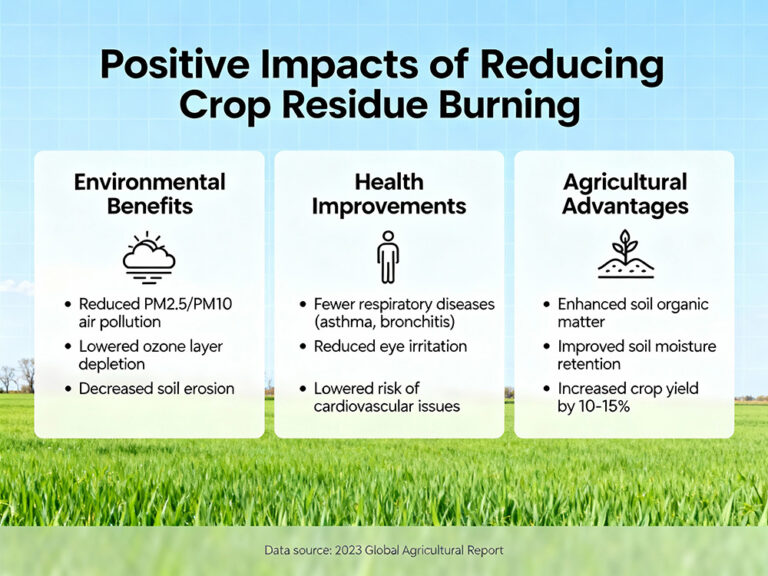
The Hidden Cost of Burning
Crop residue burning may feel like the fastest way to clear fields, but it comes with long-term consequences.
Every year, open-field burning affects soil health, local air quality, and farmer productivity. These impacts are often invisible until the next farming season.
How Burning Damages the Soil
When residue is burned, the fire destroys the organic matter that keeps soil alive.
Here’s what farmers lose:
- Moisture-holding capacity
- Soil microbes
- Nutrient balance
- Long-term fertility
Tired soil then forces farmers to use more fertilizer and water.
Impact on Air and Health
Burning releases smoke that harms both the environment and nearby communities.
It increases:
- Local air pollution
- Respiratory issues
- Greenhouse gas emissions
Farmers know it’s harmful, but there’s usually no easy alternative.
A Practical Alternative: Converting Residue Instead of Burning
The KarbonShift kiln gives farmers a simple way to recycle residue.
Instead of burning, farmers can turn crop waste into a useful carbon-rich material that improves their soil.
The process is:
- Low-cost
- Easy to learn
- Faster than expected
- Better for soil and health
Benefits Farmers Are Already Seeing
Farmers who switched from burning to using the kiln report:
- Healthier fields
- Less fertilizer usage
- Cleaner air
- Extra income from surplus carbon material
Some villages have reduced burning by more than 80 percent.
A Path Toward Cleaner Farming
Burning isn’t just a habit — it’s a symptom of limited options. By giving farmers a simple alternative that improves soil and livelihoods, the cycle finally changes.
Cleaner fields, better yields, and a healthier community all start with avoiding that first fire.